A boutique influencer agency's story
From scattered files and chats to a custom platform in 60 days: How one Influencer Agency cut offer time by 6x and tripled revenue.
Offers written manually in email. Talent rates scattered across files. Content shared through Viber and WhatsApp. A four-person agency running forty brands a month on pure effort. This is what replacing all of that looked like.
How agencies used to work — and what changed.
Creating offers for brands

Started with email templates
A proposal written from scratch every time, no structure, sent as plain text.

Then copy-paste from Notes
A rough template saved somewhere, manually adjusted per brand, easy to get wrong.

Rates from Excel spreadsheets
Opened separately, numbers copied in by hand, one mistake away from sending the wrong price.
Now: the offer builder
Select the talent, pick the services, set the quantities. Pricing calculates automatically. Offer creation went from 60 minutes to 10. Across 50 offers a month, that's a significant amount of time back.
Managing talent information and pricing
Started in the Notes app
Names, descriptions, rough rates — all in a personal note on someone's computer.
Then spread into Excel files
More structured but still manual, not shared properly across the team, easy to fall out of date.
And relied on team memory
The final source of truth was whoever remembered the last rate update.
Now: the talent database
Every influencer has a structured profile with photos, social links, and predefined service rates. Updated once, used everywhere. The whole team works from the same information.
Delivering content to brands

Content via Viber and Instagram DMs
Files came in through personal chat, one at a time, no organisation.

Forwarded via WhatsApp and email
Each re-share compressed the video. Brands received lower quality than what the influencer uploaded.
Brands stored assets wherever they landed
WeTransfer links expired after five days, so anything not saved in time had to be resent — and if the person who'd sent it was away, brands just had to wait.
Now: the brand content hub
Brands have a private link connected to their dedicated folder. They preview and download directly, at full quality, any time. "Our link saves us so much time from gathering content from different chats and emails."
Tracking offers and approvals
Tracking via email threads
Pending, accepted, or declined was buried in conversation history.
Pricing lived in someone's memory
When a brand called back, there was no quick way to check what they'd been offered or for how much.
Status updates via WhatsApp messages
"Did they reply yet?" passed between team members throughout the day.
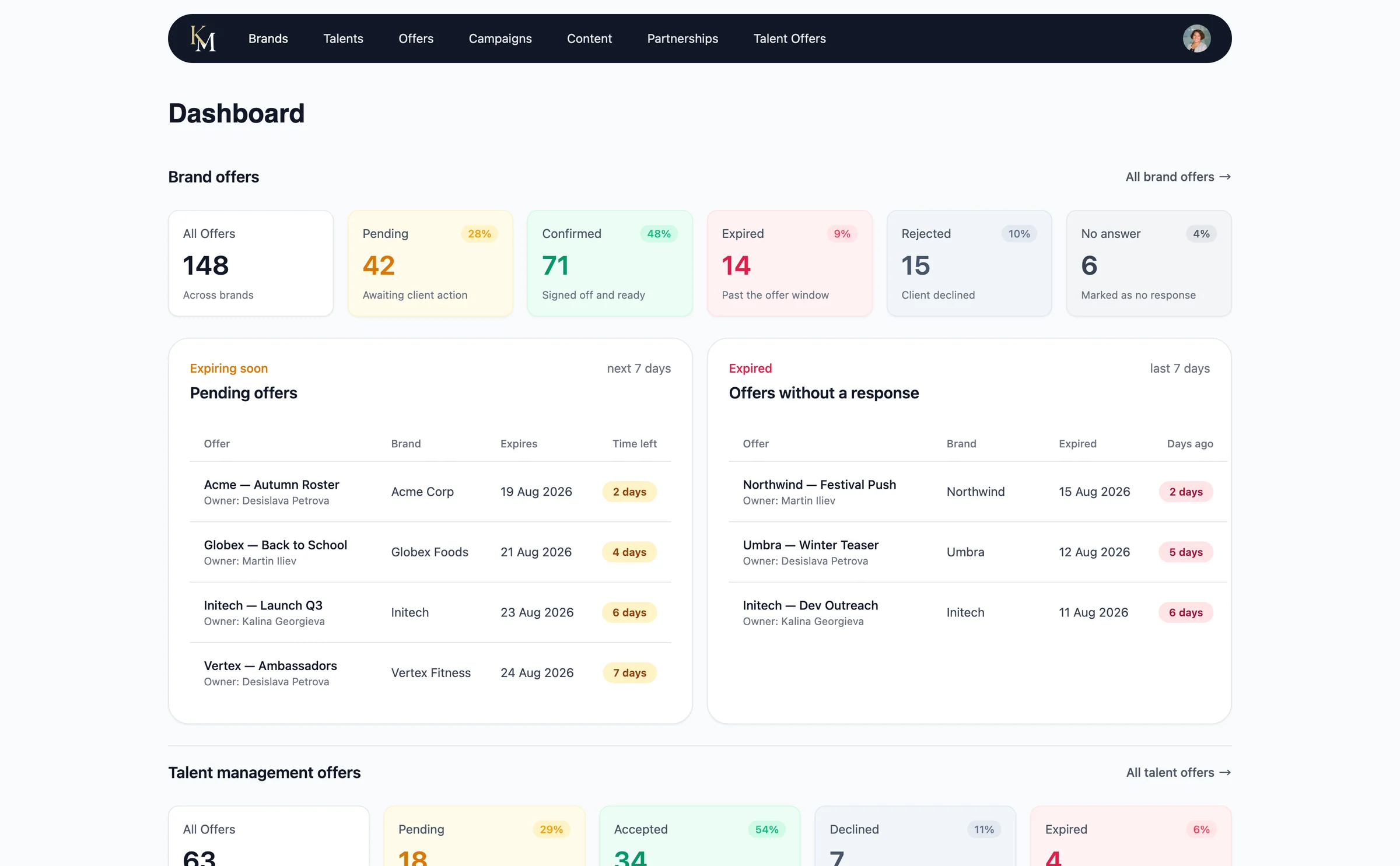
Now: the internal dashboard
Every offer is visible in one place with its current status, so when a brand calls, you know exactly what they were offered and for how much. The platform also sends reminders automatically when an offer is about to expire. 40 brands and 10 active campaigns managed through the dashboard every month.
The brand experience of receiving an offer
Brands got a plain email
No formatting, no visual structure, hard to understand at a glance.
Responses via reply email or WhatsApp
No clear accept or decline flow, just conversation threads that were easy to lose track of.
Approvals had to be chased manually
The team had no visibility into whether a brand had even opened the proposal.
Now: the brand-facing offer link
Brands receive a private link. They see the full offer, compare packages, and accept or decline with one click. No account needed, no back-and-forth.
The talent experience of delivering content
Files via Viber and Instagram DMs
A video dropped into a personal chat and hoping it reached the right person.
Every re-share degraded the quality
Talent to agency to brand — compressed each time. Talents had no idea what the brand was actually seeing.
No way to know what had been sent
No record, no confirmation, no visibility into whether a file had been received or was still missing.
Now: the talent upload link
Each talent gets a private link for their campaign. They see the brief, upload directly, and it lands in the right folder immediately. Full quality, no forwarding, no guessing. The agency is notified the moment something is uploaded.
Getting influencers to sign up for campaigns
Details via WhatsApp and group chats
Terms, requirements, and deadlines sent as a wall of text in a message — easy to miss, easy to misread.
No structured sign-up process
"I'm in" messages scattered across different conversations with no clear record of who confirmed what.
Terms rewritten every time
Personalised terms meant rewriting the same information for every talent, every time.
Now: the campaign sign-up link
Each campaign gets a dedicated page with all details, requirements, and personalised terms laid out clearly. Talents confirm participation directly through the link. No chasing, no ambiguity, a clear record of who is in and on what terms.
Sending partnership proposals to brands

Bland Word documents via email
No visual structure, no brand personality, indistinguishable from any other agency's pitch.
Content assembled from memory
Services, pricing, and benefits written from scratch each time — inconsistent from one proposal to the next.
No clear next step for the brand
A Word attachment in an inbox — no way to signal intent without replying to an email.
Now: the branded partnership proposal page
Brands receive a private link to a designed proposal page — services, packages, and benefits presented clearly, reflecting the agency's positioning. A first impression that matches the quality of the work itself.
Everything they needed, built into one platform.
Talent profiles: one place for everyone on the roster
Every influencer has a structured profile with their name, photos, description, social links, and service rates. The whole team works from the same information, so finding the right talent for a brief takes seconds instead of a manual search across social media and memory.
Rate management: pricing that is always correct
Each talent's rates for every service type — Reel, Story, Post — are defined once and pulled automatically into every offer. When a rate changes, it updates in one place and takes effect everywhere, so wrong pricing sent to a brand becomes a thing of the past.
Offer package builder: put a package together in minutes
Select a talent, choose which services to include, set the quantities, and the platform calculates the total automatically. What used to mean opening Excel, cross-referencing Notes, doing the math by hand, and typing it all into an email now takes a few clicks.
Multi-package offers: give brands real options
A single offer can include several talent packages, so brands can compare different influencer combinations in one place. Each package can be accepted or declined independently, giving brands flexibility and giving the agency clear visibility into what is landing.
Brand offer link: a proposal that looks and works professionally
Instead of a plain email, brands receive a private link to a clean, structured offer page where they can review packages and respond with one click. No account needed, no reply threads to track, and the agency can see exactly where every offer stands at any given moment.
Content hub: campaign assets in one place, at full quality
Each brand has a private link connected to their dedicated folder, where they can preview and download all campaign content directly. No more files forwarded through chat, no more quality loss from re-sharing, and no more brands asking the agency to resend things they had already received.
Internal dashboard: see every offer at a glance
Every offer the agency has sent is visible in one view with its current status — accepted, pending, or declined — along with expiry dates and package-level responses. The platform sends automatic reminders when an offer is approaching its deadline with no reply, so nothing falls through the cracks.
Talent upload link: one place to deliver, full quality every time
Each talent gets a private campaign link with the brief details and a direct upload prompt. Their content lands immediately in the correct folder at full quality, the agency is notified automatically, and there is a clear record of what has been delivered and when.
This platform was built for Kapro Me, who also got a new public website. See the website case study